
Published in: Naunyn-Schmiedeberg’s Archives of Pharmacology
DOI: 10.1007/s00210-025-04958-3
Authors: SoumitraMoulick [TCGLS Member], Tannisha Bhattacharya [TCGLS Member], Dijendra Nath Roy
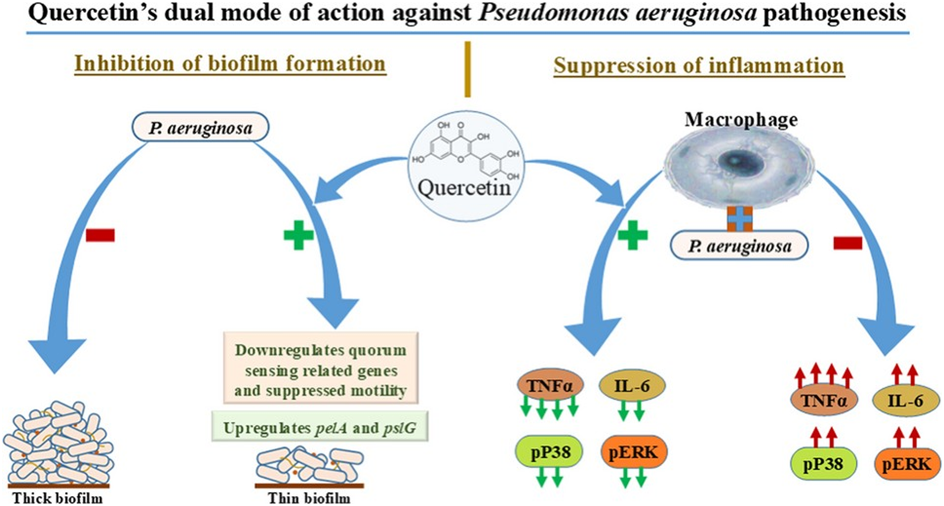
Abstract: The escalating prevalence of antimicrobial resistance (AMR) and severe inflammation associated with Pseudomonas aeruginosa infections emphasize the urgent need for alternative therapeutic strategies. This study investigates quercetin, a naturally occurring bioflavonoid, for its dual anti-virulence and anti-inflammatory properties against P. aeruginosa. We hypothesized that quercetin disrupts bacterial biofilms through novel mechanisms beyond conventional quorum-sensing (QS) inhibition. At sub-MIC concentrations (32–128 µg/mL), quercetin effectively reduced the production of pyocyanin (71%), elastase (76%), protease (53%), and rhamnolipids (57%), while inhibiting swarming motility by 60% and biofilm formation by 47%. Molecular docking revealed that quercetin binds to QS regulators LasI (− 4.22 kcal/mol) and LasR (− 5.98 kcal/mol) with high affinity. Furthermore, this study demonstrates that quercetin significantly upregulated the biofilm-degrading genes pslG (2.9-fold) and pelA (3.2-fold), which encode glycoside hydrolases responsible for biofilm matrix disassembly—a mechanism previously unreported for this compound. In P. aeruginosa-infected macrophages, quercetin (128 µg/mL) significantly reduced the secretion of pro-inflammatory cytokines (IL-6, TNF-α) (P < 0.001) by suppressing the phosphorylation of p38 and ERK1/2 in the MAPK signalling pathway. Importantly, quercetin exhibited no cytotoxicity toward macrophages at bioactive concentrations. Collectively, these findings elucidate quercetin’s distinct dual modes of action, involving the disruption of biofilms via upregulation of matrix-degrading genes and the suppression of host inflammatory pathways, underscoring its potential as a novel adjunctive therapy against P. aeruginosa infections.



@ 2021 TCG Lifesciences Private Limited. All Right Reserved.
.jpg ?>)
.jpg ?>)